How to Win at Pool Break: 8-Ball Tips & Strategy
Pool Break plays like real 8-ball: claim solids or stripes, clear your group, then sink the 8. Against the computer, the player who makes fewer mistakes usually wins. This guide covers aiming with the guide line, cue ball control, safe play and how to rack up a big score in Clear the table.
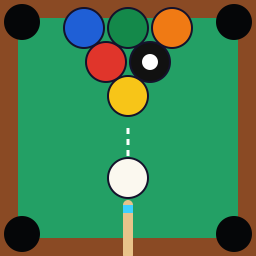 Pool Break
Play Pool Break ›
Trust the guide line
When you aim, the guide line shows where the cue ball meets the target and where the object ball will travel. Line that path up with the pocket before you shoot. If the line turns red, you are about to hit the wrong ball first, which is a foul. On a keyboard, hold Shift while turning with the arrows for fine aim on thin cuts.
Use less power than you think
Softer shots are more accurate and keep the cue ball under control. A hard shot can knock the object ball in and out of the jaws of the pocket, and it sends the cue ball flying around the table, sometimes into a pocket. Use just enough power to reach the pocket and leave the cue ball near the middle of the table.
Plan two shots ahead
Before each shot, ask where the cue ball will stop and what your next shot will be. Pick the ball that leaves you an easy follow-up, not just the easiest pot. Clear balls that are near pockets or blocking your other balls early, and leave yourself a simple angle on the 8 when your group is finished.
Avoid fouls and use ball in hand
Potting the cue ball, missing every ball, or hitting the other group or the 8 first are all fouls, and they give your opponent ball in hand. When you get ball in hand, drag the cue ball to a spot with a straight, short pot and a good angle for the next ball. Never pot the 8 before your group is cleared, because that loses the game.
Scoring big in Clear the table
In Clear the table you have five lives. A shot that pots nothing or a scratch costs one, and potting two or more balls in one shot gives one back. Combos multiply your score, so keep a run going with controlled, gentle shots. Look for clusters where one ball can knock another toward a pocket for a double pot.
Questions
- Why is the guide line red?
- Your aim would hit a ball you are not allowed to hit first, such as your opponent's group or the 8. That would be a foul.
- Where should I place the cue ball after a foul?
- Somewhere with a short, straight pot that also leaves the cue ball well placed for the next shot.
- Should I hit the ball hard on most shots?
- No. Softer shots are more accurate and keep the cue ball under control, which sets up your next pot.
Pool BreakPlay Pool Break ›